-
You do not have any saved holidays. Click the heart icon on the search or holiday pages to save a holiday.
Please note: all saved holidays will be removed when you clear your cookies!
 |
15 |
Educational |
DAYS |
 Voir les photos
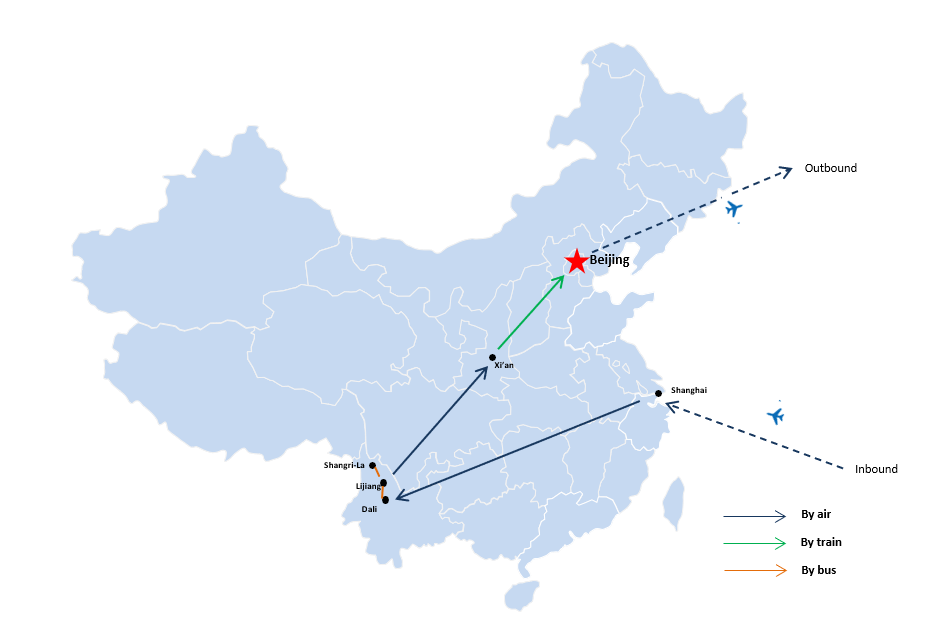
Embark on an epic 15-day journey that traverses the diverse landscapes and cultures of China, starting in the modern metropolis of Shanghai and concluding in the historic capital, Beijing.
Your adventure takes a scenic detour to the majestic southwest. You will explore the ancient towns of Dali and Lijiang, immersing yourself in the unique cultures of the Bai and Naxi minorities. Journey deeper into the highlands of Shangri-La, where you will visit the stunning Songzanlin Monastery, experience Tibetan farm life, and learn traditional crafts like black pottery and Thangka painting. Stand in awe before the Tiger Leaping Gorge, one of the world's deepest river canyons.
Returning to the central plains, you will discover Xi'an's ancient wonders, including the Terracotta Warriors and a cycling tour on the City Wall. The trip concludes in Beijing with a challenging hike on the Mutianyu Great Wall, a visit to the Forbidden City, and immersive cultural experiences in the Hutongs, capping off a perfect blend of natural wonder, ethnic diversity, and imperial history.
ARRIVAL SHANGHAI
You will be met at the airport by our guide and transferred to a hotel in central Shanghai. Gather for a welcome dinner and program orientation. Today you will have an opportunity to rest and recover from the long flight.
Accommodation 3 or 4 star hotel
Meals D
SHANGHAI HIGHLIGHTS
Half day of cultural activities in Shanghai include visits to the Art Museum and former French Concession neighborhood. In the afternoon, go to visit Yu Garden, Yu Garden is one of the most famous gardens in China and is national heritage listed. It was built in 1559 and extended in 1577. Each section of the garden is separated by curved white walls crowned with the head and body of a dragon on them. It's named after the original owner.
In the afternoon, go to visit The Oriental Pearl TV Tower and The Bund.
The Oriental Pearl TV Tower is unquestionably an icon of Pudong’s renaissance. Looming through the mist, like a reproduction of a classical Chinese ink painting of landscape, stands Shanghai’s Oriental Pearl TV Tower. Its soaring height of 468 meters boldly characterizes the Lujiazui cityscape.
The Bund: Also called the Zhongshan Road, is a Famous waterfront and regarded as the symbol of Shanghai for hundreds of years.It was the centre of Shanghai’s politics, economy and culture hundreds of years ago, consulates of most countries and many banks, bus inesses and newspaper offices were settled there.
Accommodation 3 or 4 star hotel
Meals BLD
SHANGHAI - DALI
Free in the morning, drive to the airport to catch a flight to Dali in the afternoon. Your guide in Dali will meet you at the exit of the airport, then drive to a 3/4 star hotel in center Dali. Free in the evening.
Accommodation 3 or 4 star hotel
Meals BLD
DALI
After breakfast we continue our journey to Xizhou Bai Village morning market, Xizhou village 23 kilometers north of Dali, has a more mixed population and cosmopolitan background. It grew and flourished in the Ming Dynasty (1368-1644) along with the fortunes of Dali’s renowned tea merchants that traded toTibet. Family Yang’s courtyard is a good example of traditional Bai houses. And each morning, villagers in Bai dresses gather in a small market to buy and sell their produce and daily wares. Here, you will also enjoy Three-coursed Tea accompanied with folk song and dance performance, a ceremony of the Bai people to greet guests.
We will take a cooking class in Zhoucheng Bai Minority Family. Have a glimpse of food Specialties of Bai people.
After lunch, visit the Three Pagodas. Standing in a way of a tripod on the outskirts of old town, the Three Pagodas were constructed in about 850 and 1050 following the model of the Small Wild Goose Pagoda in Xi’an. For centuries, they are considered landmark of the region.
Rest of afternoon will be guided stroll in the old town ofDali. The old town of weathered gray granite stands at 2,100 meters on a long, narrow rice plain between the Cangshan Mountains and the Erhai Lake, a natural àconfiguration that seems specially designed for a good, bountiful life. Format of the old town is like a chessboard with four gates guarding in the directions of east, south, west and north, a design that was adopted by most towns in ancient China.
Accommodation 3 or 4 star hotel
Meals BLD
DILI TO LIJIANG
Drive to Lijiang, drive of 180 kilometers, approx. 2.5 hours, along the new road to Lijiang. Lijiang is a gathering place of rugged mountain people with the Naxi forming the majority. Lijiang is a small mountain town of stone and tile, laced with swift canals, which has been recently listed as an UNESCO world monument.
Upon arrival in Lijiang, check in, and then take a guided stroll in the Old Town. Old town ofLijiangis a big area with its center, or Si Fang Jie (Square Street) in the form of an official inks stone, hence its name Dayan (ink stone) Town. It enjoys a long history of over 800 years and unlike most of the old towns inChina, there is no city wall due to a superstitious belief of the local ruler whose family name is Mu (tree), when encircled by walls, would be Kun (besieged). Wooden structures, mountains, small rivers and lanes integrate harmoniously in this mountain town. visit Mu Prince Residence, It was the palace of the headmen of Lijiang of the Ming Dynasty (1368-1644), deserved to be a grand view park of the culture of Ancient Lijiang City. The palace, located at the southwest corner of the ancient city, is a large group of buildings, an imitation of the Forbidden City inBeijing. Among them the Loyalty Stone Arch, with spectacular looking and superb workmanship, may be rated as a treasure of China.
Accommodation 3 or 4 star hotel
Meals BLD
LIJIANG
This morning, we will go to explore a morning market near the ancient city. Then go to visit Yuhu Village. Doctor Joseph Rock House. Yuhu Village is at the foot of Jade Dragon Snow Mountain.The houses were made of a unique stone called monkey head by Naxi people. The stone is comprised of a substance between stone and mud. With the reflection of the stone on the snow mountain, the village looks even more peace, natural and beautiful.
This lovely atmosphere is why Austrian American explorer Dr. Joseph Rock, chosed this place to live when he came in 1922. He lived in Lijiang for 27 years. In the village one can still see the house he lived in and many of the daily tools he used. From 1924, a large number of his photos and articles depicting Lijiang have been published in National Geographic. His work was instrumental in introducing the wonderful scenery of West Yunnan to people in the West. Rock loved Lijiang very much. He wrote to his friends just before his death in 1962 that he'd rather die in the flowers of Jade Dragon Snow Mountain in Lijiang than lie alive on a sickbed in Hawaii.
Continue to visit Baisha Fresco and Baisha old town. 16 kilometers away from Lijiang city, Baisha is an ancient and beautiful town, iis the original settlement of Naxi people in Lijiang dam, and also the birthplace of Lijiang Tusi Mu family, also the earliest Naxi political center. The famous "Lijiang Mural" is the product of the opening of Naxi society in Ming dynasty, it was painting from Ming to Qing dynasty, has lasted for over 300 years.
The valuable murals are protected inside Dabaoji Palace and the colored glaze temples. The originality and figures within the murals reflect the different religious cultures and artistic forms of Buddhism, Lamaism, Taoism and local Naxi Dongba religion's development into Naxi School. Each painting includes at least one hundred portraits, which are not only Buddha, but also ordinary people .It shows the Tibetan Buddhism , Confucianism, Taoism , Naxi Dongba and other life stories.
The highlight of today is learn some Dongba Pictograph from old Dongba ( Naxi master)
In the late afternoon, drive back to Lijiang.
Accommodation 3 or 4 star hotel
Meals BLD
LIJIANG - ZHONGDIAN
After breakfast , take private bus to Tiger leaping gorge (Tiger Leaping Gorge (pinyin: Hǔtiào Xiá) is a canyon on the Yangtze River – locally called the Golden Sands River (金沙江 Jīnshā Jiāng) – located60 kmnorth of Lijiang City. This gorge is formed by two mountains—theJadeDragonSnowMountainand the Haba Snow mountain, with the river flowing in between called theGoldenSandRiver. This gorge is about3700mfrom the top of the mountain to the water surface, and about15 kmin length. It is said that once, in order to escape from the chasing of a hunter, the tiger has to leaping from this side to the other side of the river, the rock that the tiger used now is become the core of this gorge—the ‘tiger leaping stone’ also called the ‘upper tiger leaping gorge’, which is only 30 meters in between the two sides of the river. There we will do a short hike race to exercise the student team consciousness, after lunch, visit the upper tiger leaping gorge.
In the afternoon, drive to Zhongdian (also named shangelila), tour to the old town of Dukezong, it is no youngster—at 1,300 years old, the city boasts a formidable history. Showcasing traditional and authentic Tibetan dwellings, the small town provides a snapshot of the past. Once a stop along the Ancient Tea Horse Road, the town has come a long way from its heyday as a major port of trade in the region. But the city has retained much of its ancient charm and Tibetan identity; indeed, the town maintains its layout in the shape of a lotus flower, and you're likely to stumble across a gathering of locals strumming their traditional instruments, especially in the evening.
Accommodation 3 or 4 star hotel
Meals BLD
ZHONGDIAN
In the morning, drive to Songzanlin Monastery (Sōngzànlín Sì),. Located at the foot of Foping Mountain (Fúpíng Shān), also known as the Ganden Sumtseling Monastery, is the largest Buddhist monastery in Yunnan, and is modeled closely on the Potala Palace in Lhasa. Originally built in 1679, the Songzanlin complex, ordained and inhabited by the fifth Dalai Lama, sits at an elevation of3,300 m(10,827 ft) and boasts three temples and an eight-meter-high statue of Sakyamuni.
Transfer to Napahai Lake Nature Reserve, enter inNapa Village, we will divide all the participants into different groups, arrange them to different households to participate in Tibetan farm labor (For Tibetan, February is the season to sow barley and rape), enjoy a simply lunch at noon in local farmers’ house. After lunch, we will organize the group to do voluntary labor, like pick up garbage, and then play basketball. Return to households to enjoy a splendid Tibetan hot pot dinner at five o’clock, after dinner, back to Zhongdian.
Accommodation 3 or 4 star hotel
Meals BLD
SHANGRI-LA TO LIJIANG
This morning, check out the hotel, then drive to visit Nixi Tibetan village. At there, we will have a chance learn how to make Nixi Black Pottery by hand.
*Make Pottery by yourselves and have a team Competition.
Lunch: Chicken hot pot cooked by Nixi Pottery
After lunch, drive to Thangka Center. You can see the Thang-ga painting in academy. Thang-ga is a unique style of painting developed in the 7th century in the Tibetan area. Thang-ga is a Tibetan word which refers to the scroll painting mounted with colorful satins and fabrics. Learn how to make Thangka
Drive to Lijiang in the afternoon, have dinner first, then check in the hotel in Lijiang.
Accommodation 3 or 4 star hotel
Meals BLD
LIJIANG - XI’AN
Take an early morning flight to Xi’an. Upon
arrival, transfer to the hotel, check in and have a short rest. Then begin our
tour with a bicycle ride along the Ancient City Wall,
the most complete city wall in China. The original foundation was based on the
ruins of the Imperial City Wall of Chang’an City, the capital of the Tang
Dynasty, known today as
Followed by a stroll with our guide in the Muslim
Quarter and the visit to the Big Mosque, where the way of life is markedly different
from the traditions of the Han Chinese. For over 1,300 years, since the Tang
Dynasty (A.D. 618 - 907), Muslims have been an integral part of daily life in
We will enjoy Shadow Puppet show in Gao’s family. It is an ancient form of storytelling and entertainment using opaque figures in front of an illuminated backdrop to create the illusion of moving images.
Accommodation 3 or 4 star hotel in Xi’an
Meals BLD
XI’AN HIGHLIGHTS - BEIJING
After breakfast, we will drive to visit the magnificent Qin Terra-cotta Army. It was built in about 2500 years ago and contains more than 6000 warriors, soldiers and horses. UNESCO listed it in 1987 as one of the world cultural heritages.
After visit, transfer to Xi’an North Railway station to take a high-speed train to Beijing. Upon arrival, transfer to the hotel and have a rest. Dinner will be followed.
Accommodation 3 or 4 star hotel in Beijing
Meals BLD
BEIJIKNG HIGHLIGHTS
This morning, you will be driven to Beijing Opera Art School to learn more about Beijing Opera by visiting school Opera exhibition and joining the classes of Beijing Opera movement and face painting in the school.
Continue to visit Hutong neighborhood, a hutong is a unique form of community that exists only in China. Here you will find “Hutong Culture” and “Courtyard Culture”. Hutong literally means a small street or lane between two courtyards, although the word can also mean a community within the city consisting of hutongs and residencies. As Beijing has modernised, many hutongs have been demolished to make way for high-density living and commercial areas. The government has decreased the “no demolition” zone and now many hutongs are being bought and modernised. Hutong properties are probably the most expensive in Beijing. In the hutongs, discover the hidden gems of Beijing and one of the last surviving areas of ancient China. Participate in all kinds of cultural and traditional games including cricket fighting, calligraphy, paper cutting. Dumpling making and lunch at a Hutong family’s house.
Discover the wonderful atmosphere of a traditional Chinese Tea Ceremony in the afternoon.
Tea was and remains a central piece in the Asian cultures, especially in China where it first originated.
Enjoy a delicious Peking duck dinner - the capital's most famous dish. Once imperial cuisine, now the leg endary duck dish is served at restaurants around the world.
This evening we will go to watch a Chinese opera performance.
Accommodation 3 or 4 star hotel
Meals BLD
MUTIANYU GREAT WALL - 798 ART DISTRICT
Today, we will first go to visit the Great Wall at Mutianyu- the most beautiful section of the walls in Beijing. Hike on the wall. Lunch, travel back to the city to visit the 798 Art District in the afternoon. Drive back to the hotel.
Mutianyu Great Wall is one of the famous sections of China Great Wall. It was first built in the mid-6th century during the Northern Qi, making it older than the Badaling section. In 1569, the Mutianyu Great Wall was rebuilt and till today most parts of it are well preserved. The Mutianyu Great Wall has the largest construction scale and best quality among all sections of Great Wall.
After back to Beijing, enjoy a guided tour of Art District 798.
Art District 798 is located in the Dashanzi area. At the beginning of 2002 artists and cultural organizations began to divide, rent out and re-make the factory spaces gradually developing them into galleries, art centers, artists’ studios, design companies and restaurants.
Accommodation 3 or 4 star hotel
Meals BLD
BEIJING HIGHLIGHTS
This morning, we will transfer to visit the Summer Palace. Summer Palace located in a northwestern suburb of Beijing; it is an immense park containing some Chinese traditional architecture and arts. It was built and served as a royal garden during the Qing Dynasty. It exhibits the quintessence of the Chinese classical landscape gardening. The halls, the pavilions, the corridors, the pagodas, the bridges and the water were elaborately arranged. The long Corridor is one of the most exquisite structures in the garden. It is over 700 meters long and decorated with thousands of Chinese traditional paintings.
After lunch, follow in the footsteps of emperors, court ministers and eunuchs and head south to the magnificent and colorful Forbidden City. Forbidden City Beijing, also called Imperial Palace Museum, is located in the very heart of Beijing. It remained the residence of the emperors for nearly five hundred years, from the 15th century to the early 20th century, and was the actual and symbolic seat of imperial power. Popularly known as the Forbidden City, it was built in the Ming Dynasty between the 4th and the 18th years of the Yongle period (1406 - 1420 AD). Many of the buildings of the Palace have been repaired and rebuilt, but their basic form and layout remain in their original state.
After that, we will go to visit the Temple of Heaven. Temple of Heaven was the venue for the Ming and Qing emperors to offer sacrifices to the Heaven and pray for harvest. This temple was built in the 18th year during the reign of the Ming Emperor Yongle in 1420. We will have a chance to see the local people doing their exercises in Temple of Heaven. Tai Chi, or Taijiquan in China, is an outstanding gem of traditional Chinese culture that is valuable in promoting health, developing combat and self-defence skills, and improving concentration and overall well-being.
Accommodation 3 or 4 star hotel
Meals BLD
BEIJING - HOME
Breakfast served at hotel. Pick up from hotel and transfer to airport to take flight departing Beijing and back home.
Meals B
Additional details
1. Before you pay deposit to book the tour, we haven’t made any reservation yet. The train, flight tickets and the hotel may different from the itinerary listed.
2. The visiting order of the scenic spots in the itinerary may change according to the traffic condition and other unforeseen things.
3. Tourist insurance is a must before going, please provide us the confirmation of insurance company when sign up.
The price includes
1. Entrance Fees: to scenic spots as listed in the itinerary
2. All the activities fee mentioned in the itinerary: Hutong rickshaw in Beijing; Sichuan Opera show in Chengdu;
3. Private Transfers: Transfers between airports, hotels and scenic spots while sightseeing during the trip by private air conditioned vehicle with a driver.
4. Meals: All meals as indicated in the itinerary (B-breakfast, L-lunch, D-dinner), include Peking duck dinner in Beijing; Hot pot dinner in Chengdu.
5. Guide: As outlined in the itinerary an English-speaking guide and driver will be provided in each city, who will remain with you throughout your time in that city. A new guide and a new driver will meet you at each city on your tour, to provide you with the best local knowledge available
6. Hotel: hotel fees are based on two people sharing one room with king-size bed. All hotels as listed in the above itinerary serve daily western or Chinese breakfast
9. Arrangements: the tour cost includes planning, handling, operational and communication charges
10. Travel Agency Liability insurance
The price does not include
1. International airfare or train tickets to enter or leave China
2. China entry visa fees
3. Excess baggage charges
4. The medicine for the sickness or accident while on the way
5. Personal expenses: expenses of a purely personal nature such as laundry, drinks, fax, telephone calls, optional activities, sightseeing or meals which are not included in the tour itinerary
6. Meals: any meals which are not specified in the tour itinerary
7. Single room supplement
8. Please notice that the price will be much higher during the festival of Labors’ Day, National Day, spring festival
9. Tips to tour guide and driver (recommended USD10-15/guest/day).
10. Tourist accident insurance. NB - you are strongly suggested to buy travel and health insurance before you start out from your home country.
Payment conditions
To confirm your reservation, you must pay a deposit of 30% of the total amount due via the payment link that your local agent will share. The balance is due 30 days prior to departure. The quoted exchange rate is valid for the next 7 days – if the deposit is not paid within this time, the quote will be re-calculated.
Terms and conditions for cancelation
i. Cancellation of the Tour by CAT (local agent):
CAT reserve the right to cancel the postpone tour at any time up to the date final payment is due under the following condition: in our opinion, health and/or safety factors related to conditions in China would make the tour inadvisable. And in this case, all money paid by the participants will be refunded. If the tour is postponed, CAT will offer all those who have signed up the opportunity to have the same tour for a later time, but the price may be changed according to the season. We will notify you of any change, and give you a reasonable period
of time to make your decision. Consumers may, but are under no obligation to, take the tour under these new terms. After final payment has been made, we may cancel the tour only if, in our opinion, health and/or safety factors related to conditions in China would make the tour inadvisable. Since cancellation in this case involves factors which may arise suddenly and are entirely outside our control, including but not limited to natural disasters, civil unrest and epidemic disease, we cannot guarantee a full refund in this case. This is because payment will already have been made to finalize the arrangements and reservation.
ii. Cancellation of the Tour by Consumer:
Any cancellation must be made by sending an email to the local agent. The cancellation fee varies according to how many days prior to departure the cancellation is made:
· More than 30 days prior to departure: 5% of the total holiday cost
· Between 30 and 22 days prior to departure : 25% of the total holiday cost
· Between 21 and 8 days prior to departure : 50% of the total holiday cost
· Between 7 and 3 days prior to departure : 75% of the total holiday cost
· Less than 3 days prior to departure and after the departure date: 100% of the total holiday cost
All cancellations must be in writing and will be effective upon receipt by CAT. No refund will be made to those participants who break the journey regardless of the portions of the package unused. If, owing to serious illness or injury, the participant withdraws from the tour, a refund will be subject to the consent of the local travel agent.
No refund will be made to those participants who have failed to secure valid travel documents such as passport or visas.


